Ms. Dinger
Honors English II
9 December 2024
Life Imitates Art: Bradbury, Vonnegut, and January 6, 2021
In the last decade, demagoguery, violent rhetoric, and fearmongering have fractured America’s political climate to the point that political violence is no longer a question of “when,” nor “if,” but of “how often.” On January 6, 2021, political polarization manifested as a riot at the Capitol. Underlying these social ailments, however, is a deep structural issue. Ray Bradbury and Kurt Vonnegut wrote in their short stories “Harrison Bergeron” and “The Pedestrian,” respectively, of portentous developments in technology. In these two stories, they predicted the overwhelming power of mass media to shape the information landscape, which today leads to polarization and violence.
Bradbury and Vonnegut were both concerned with the development of two technologies of the twentieth century: the television and the radio. “The Pedestrian,” for instance, envisions a future where television centralizes societal sources of knowledge. He compares future homes to “tombs, ill-lit by television light,” their inhabitants “[sitting] like the dead” (Bradbury 2). Employing the cramped connotations of tombs, he suggests the homes’ inhabitants’ withdrawal from the outside world; people stay at home, deriving knowledge solely from television. Given his comparison of the neighbors to the dead, he implicitly critiques the role of mass media in shaping public opinion. Vonnegut’s imagined future, featured in “Harrison Bergeron,” is more insidious. In his world, radio distracts Americans from truth and critical thinking. George receives “sharp noise” through the radio, preventing him from “[taking] unfair advantage of [his] brains” and remembering important news events (Vonnegut 1). By utilizing colloquial language, such as “brains,” Vonnegut implies that the society accepts distraction and mental repression, though his description of the noises as “sharp” and therefore painful illustrates his disdain for the practice. Through his vision of a populace rendered powerless by radio, he warns of its capacity for danger.
Though both short stories involve future worlds, mass media already negatively shapes public narratives in the present. In a recent defamation lawsuit, Fox News “[won] back viewers” by airing false claims about the 2020 elections to audiences disappointed about the outcome (Bauder). Bradbury’s criticism of television is especially apt here. Like in “The Pedestrian,” Fox does not forcefully centralize news, but influences audience understanding of events. They present fake but compelling news stories, which thus lead more people to believe false claims.
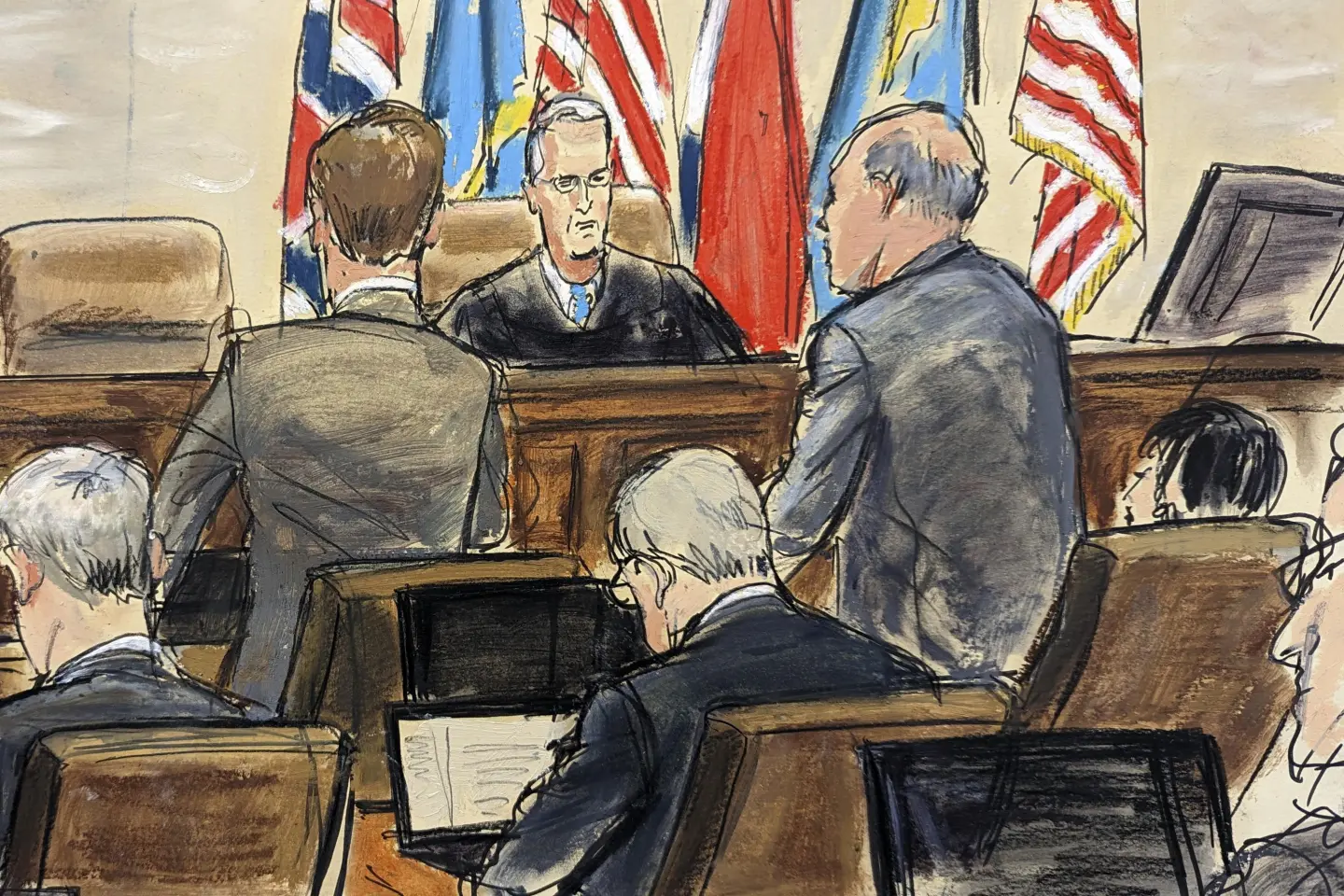
Dominion Voting Systems attorney Justin Nelson, standing left, and Fox News attorney Daniel Webb, standing at right, speaking to Judge Eric Davis before finishing jury selection in Delaware Superior Court Tuesday, April 18, 2023, in Wilmington, Del (Williams).
Their false claims also mirror the distracting noises in “Harrison Bergeron” in that both distort truth and harm audiences; misinformation “inspired [rioters] to take up arms” on January 6, 2021 and cause an insurrection, killing several (McCarthy). Because misinformation incited the insurrection, Fox’s election fraud news must have directly contributed to the insurrection’s force; the authors’ fears of media control of knowledge have not only become reality, but have led to substantial damage.

People listen as then-President Donald Trump speaks during a rally Jan. 6, 2021, in Washington (Vucci).
Bradbury’s “The Pedestrian” and Vonnegut’s “Harrison Bergeron” demonstrated how television and radio could be exploited to nefarious ends. Today, life imitates art; mass media shapes the information landscape in an unprecedented manner, and often in negative ways. Their rapid spread of information often leads to polarization and violence, as manifested on January 6. Now more than ever, Bradbury and Vonnegut prove prophetic.
 Bauder McCarthy Vucci Williams
 en-dimension by dylan zhong